Integrating Robotic 3D Printing and Milling for Fabricating Curved Topological Interlocking Systems
This study addresses the challenge of fabricating topological interlocking (TI) blocks for curved surfaces, where precision and geometric alignment control are crucial for successful assembly. While TI systems offer inherent stability and design flexibility, their use on non-planar geometries is constrained by the difficulty of producing accurate interlocking interfaces.
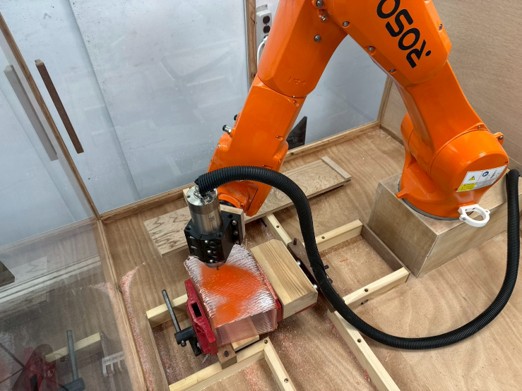
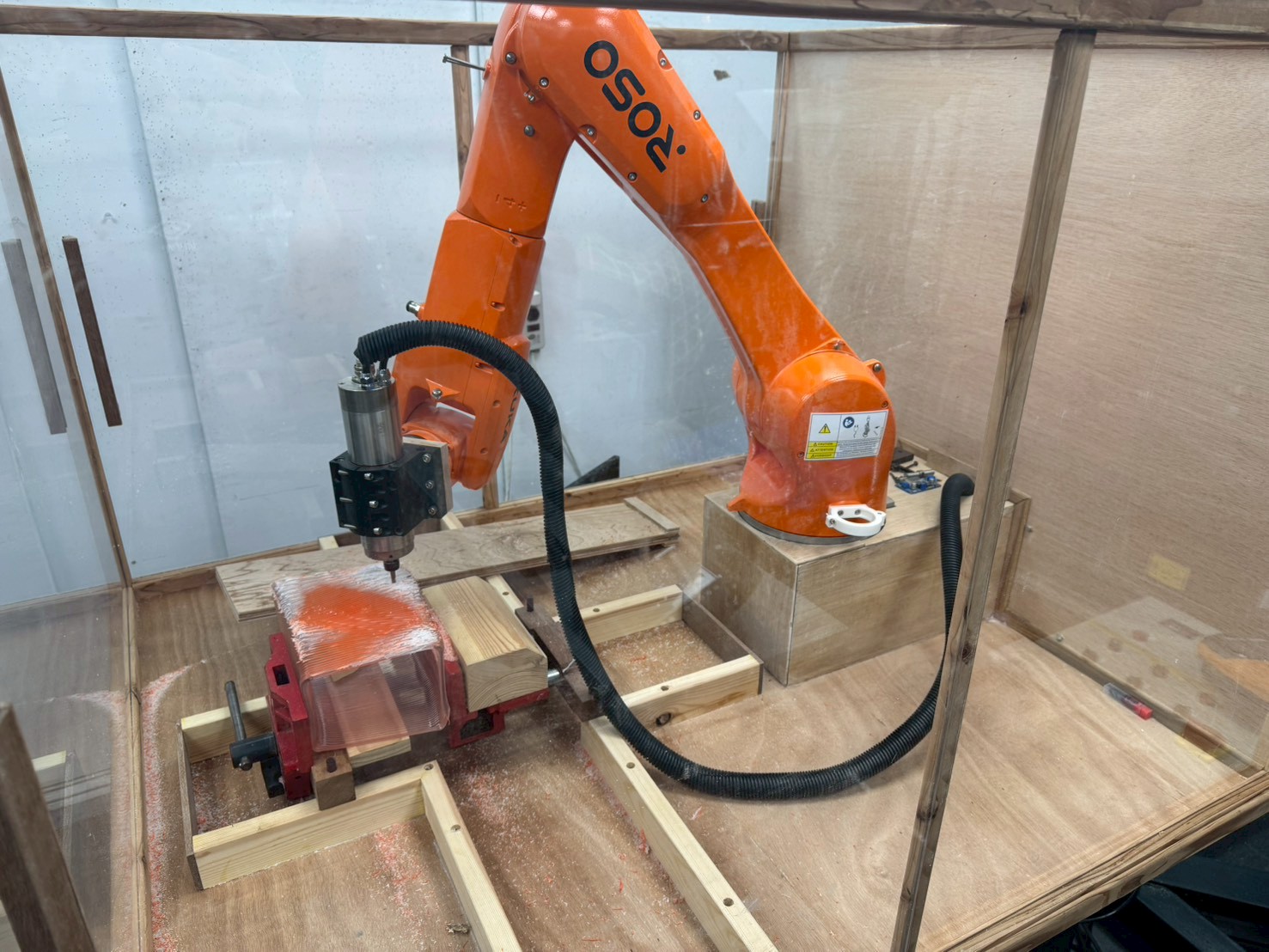
To overcome this, a hybrid fabrication workflow integrating robotic 3D printing and milling is developed to detect and compensate for deviations between the digital model and the fabricated geometry. Curved surfaces are computationally discretized into interlocking blocks and fabricated using PETG, a recyclable thermoplastic.
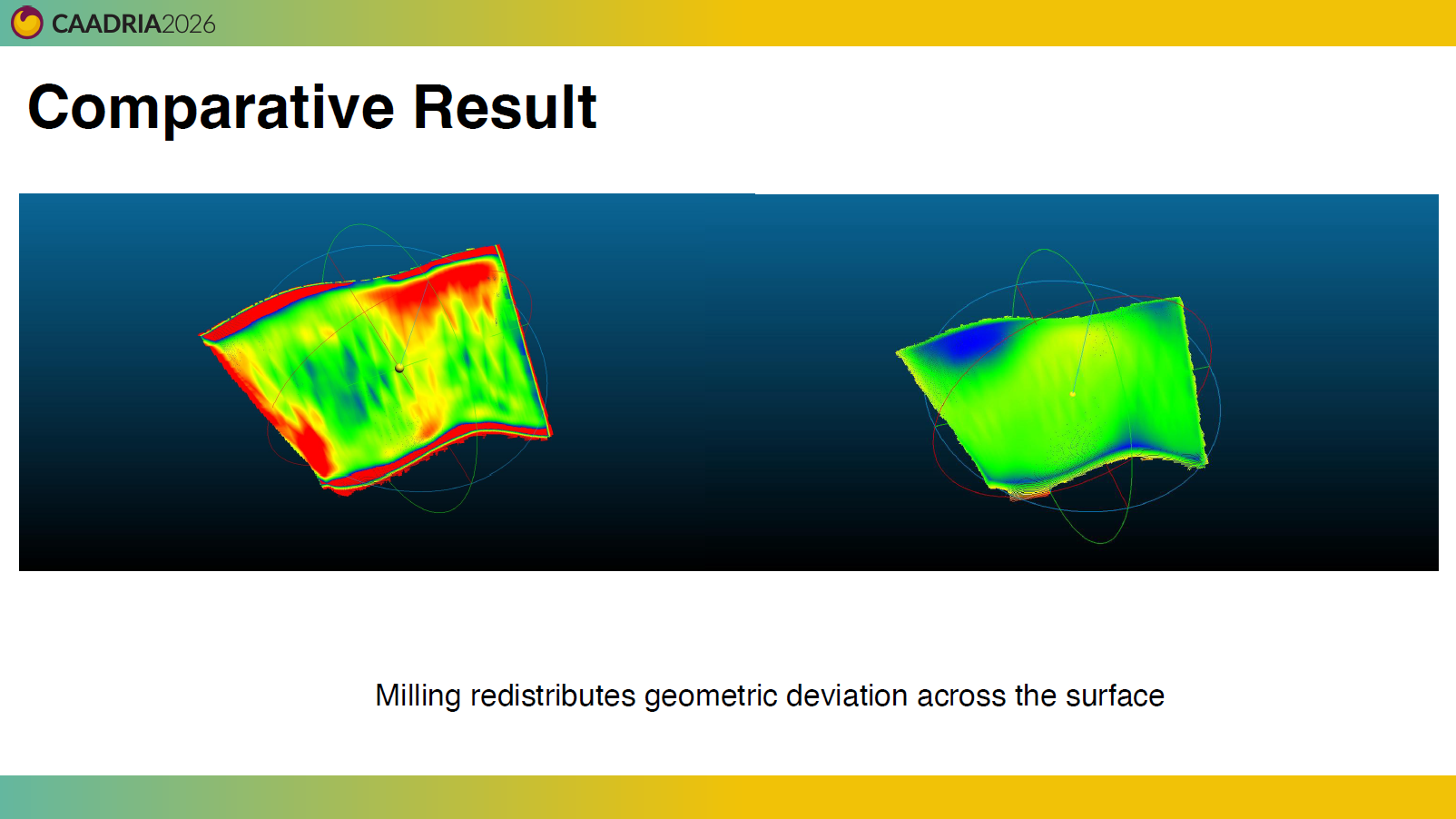
A scaled prototype demonstrates that the proposed hybrid workflow improves surface quality and assembly precision, reducing average misalignment by approximately 60% compared to the purely additive process. These results highlight the potential of hybrid robotic fabrication as a sustainable and material-aware strategy for realizing complex topological interlocking architectures.
Introduction
Advancements in robotic construction have been a major research focus in recent decades, with numerous studies exploring the potential of robots in both fabrication and assembly (Gharbia et al., 2020). In parallel, dry-stacking masonry systems such as topological interlocking (TI) demonstrated exceptional stability and reusability through geometry-based assembly (Dyskin et al., 2013). When applied to curved surfaces, TI systems offer compelling architectural possibilities but also present significant challenges in fabrication and assembly. However, the complex geometry of TI blocks poses fabrication challenges when using conventional methods.
Robotic additive manufacturing enables the production of complex TI geometries through non-planar 3D printing (Sheng et al., 2023), while subtractive robotic milling can refine interlocking interfaces for higher precision. Yet, these processes are rarely integrated into a single adaptive workflow capable of reconciling deviations between digital design and fabricated geometry.
This study presents a methodological prototype for hybrid additive–subtractive fabrication of curved TI blocks, focusing on workflow development rather than full quantitative evaluation. This study will integrate design, fabrication, and assembly through two main stages: (1) topological interlocking block design, and (2) 3D printing - milling robotic fabrication. PETG, a recyclable thermoplastic, was selected as the printing material due to its balance of mechanical performance and demonstrated recyclability in additive manufacturing (Bremer et al., 2022).
Building on prior research in curved-surface TI discretisation (Harsono et al., 2025), the proposed method begins by subdividing curved geometries into osteomorphic TI blocks using clustering-based techniques. These units are then fabricated through robotic 3D printing with non-planar deposition to capture geometry-specific variation, followed by robotic milling to refine interlocking interfaces and improve edge accuracy. A scaled prototype validates the workflow, demonstrating that the hybrid fabrication process effectively bridges the gap between digital design and physical constructability while addressing both geometric precision and material sustainability. Moreover, this research contributes to the broader discourse on hybrid fabrication workflows by presenting a geometry-driven coordination between additive and subtractive robotic processes.
Discussion and Methodological Reflection
computational design with robotic making. By pairing additive deviation with subtractive correction, the workflow treats fabrication error not as a flaw to be eliminated, but as a controllable design parameter that mediates between digital precision and material behaviour. Here, accuracy is reframed as a negotiated condition, where imperfection becomes both measurable and designable. Although the fabricated prototype simplifies the osteomorphic curvature for feasibility, the same parametric framework can be extended to support more complex surface-correction strategies.
From an assembly perspective, topological interlocking systems do not require zero-tolerance precision, but instead operate within a functional tolerance envelope governed by interface contact, friction, and boundary constraints. In the presented prototype, deviations exceeding approximately 6 - 8 mm resulted in visible gaps and localized loss of contact, impeding smooth assembly. After subtractive refinement, the remaining deviation (approximately 3 - 4 mm) enabled continuous interface contact and allowed manual assembly without forced fitting. These results indicate that the hybrid workflow successfully shifts fabrication error from an assembly-limiting range into a functionally acceptable tolerance band for curved TI systems.
Several methodological insights emerge from this study:
- Design decisions directly influence fabrication feasibility; curved surfaces should be discretized to minimize local curvature while retaining at least one planar face to ensure printing stability.
- Continuous toolpaths are essential for maintaining uniform layer deposition during robotic 3D printing.
- The subtractive milling stage plays a critical role in refining interface geometry and compensating for discrepancies between digital and physical models, reducing misalignment compared to the purely additive process.
Despite these improvements, several limitations remain. The evaluation is preliminary and largely visual, as comprehensive quantitative deviation and surface analyses have yet to be conducted. Measurements were performed manually using a digital caliper (±0.01 mm precision); future work will employ 3D scanning to generate full-surface deviation maps and support more rigorous geometric validation. In addition, the current study is limited to small-scale PETG assemblies. Future research will extend the framework to larger scales, alternative material systems, and structurally relevant testing scenarios.